Velcro Woven Patches: A Sewist’s Guide to Removable Customisation

Description
People that sew are natural customizers. We alter clothes to add pockets or shorten hemlines. Some of us should be more adventurous and remove the commitment of permanently attaching patches to fabrics. A good system has patches that can be interchanged. This gives the wearer the ability to change the patches based on their preference. This is especially convenient for people that make custom team uniforms or bags. The patches should have a hook and loop backing so that they can be easily removed and replaced. Compared to using an adhesive or stitching the edge of the patch, using hook and loop backing increases the ease of use of the patch by quite a bit. This article will explain more about this system and how to use it in your projects. It’s meant to be used by people that have some experience using a sewing machine.
What Makes a Woven Patch Different from an Embroidered One
There’s a lot of confusion around woven and embroidered patches. They’re not the same thing. Embroidered patches raise the design of the patch above the base fabric. Woven patches are created with a loom to create the design of the patch. Woven patches are better to use to represent lettering and other detailed images, compared to embroidered patches of the same size. This is because with woven patches, the design is created by narrow, interlocking strands of thread. With hook and loop fasteners, like those found on most patches, the woven face of the patch is attached to the fastener. Because there is no embroidered edge to maintain the shape of the patch like there would be with an embroidered patch, the woven patch is more pliable and can conform to the shape of the object to which it is attached.
How Velcro Backing Works on a Woven Patch
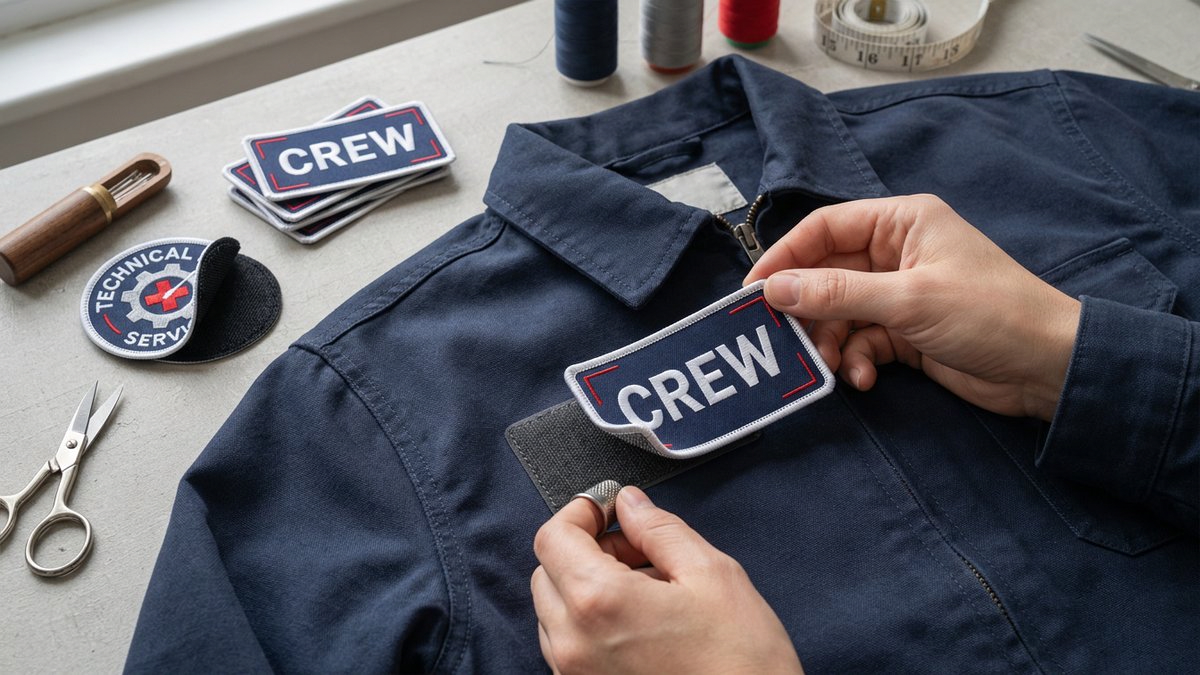
Velcro consists of two pieces, one with many small hooks and the other with a soft, looping surface. To attach a Velcro patch to something removable, both pieces of Velcro have to be included in the design. Otherwise, the patch cannot be removed. There are two varieties of this design. In the first variation, the hook side of the closure is sewn to the patch. In the other variation, the loop side of the closure is sewn to the patch. Which of the two variations is used is determined by what the patch is being sewn to. Suppliers of hook and loop closure systems offer a double sided Velcro patch where one side is attached to the patch and the other is to be sewn to the garment. The key, by default, is to determine what is on the other side of the closure to best decide on which variety of hook and loop closure to use.
When to Choose Velcro Over Sew-On or Iron-On
The backings have tradeoffs and benefits unique to each situation. Sew-on is best to use when the patch will be exposed to heavy wear and when the garment will be machine washed with hot water. Sewing on the patch also means that the removal of the patch will leave holes in the fabric. Iron-on backing makes the most quick and easy patches, but will damage the fabric when the patch is removed. Velcro backing is best to use when you need to be able to remove the patch regularly. This is commonly used on children’s clothing to attach patches for different seasons. Like iron on and sew on backings, Velcro has its own set of trade offs. It adds extra bulk to the garment, and the hook side can collect lint and snag fabric. Velcro should not be used in place of sew on or iron on backings. Some situations do require the use of Velcro. For example, a school blazer that needs a house patch to be removed and replaced at the start of each school term, or a tote bag that needs to be customized for each batch of market items.
Planning a Removable Patch System for a Sewing Project
It’s best to design in a removable patch system before construction. First, decide on the receiving surface. If the fabric of the bag or garment doesn’t have loop side of the Velcro, attach a panel to it first using either stitching or adhesive. This panel should be bigger than the largest patch you plan to use. Once the panel is attached, you can decide on the size and shape of the patches. Smaller patches are harder to align on a curved surface. Shapes with obvious orientation are easier to align than irregular shapes. When using a removable patch system, higher difficulty is associated with smaller sizes. Larger sizes are easier to handle for young users. Once you’ve determined the patches’ size, shape, and number, attach the appropriate backing to the receiving surface. The most common reason a user feels a patch is not securely fastened to the surface is due to use of the wrong side of the Velcro. Before construction, check with the supplier to find out which side of the Velcro is the hook and which is the loop. Once these steps have been completed, check the firmness of the hold by removing and replacing the patch several times. If the patch doesn’t stay in place, it may be too large for the receiving surface.
Common Mistakes with Velcro Patches
When adding a patch, leave ample space around the edge of the panel. The patch should come off easily before garment washing.
Users often remove the correct half of the fastening system to create a hook and loop closure. The correct panel must be attached to the hook side of the patch in order for the closure to work. Also, patches should not be made too small or they will not adhere properly to the panel.
Exposing the hook side of a patch can also cause problems. Hooks can snag delicate fabrics like knitwear. To avoid this, use a loop side panel to cover the hooks. Users sometimes assume that once a hook and loop closure patch is in place it is ready to be washed with the garment. This is not the case. Heat and the friction of washing against the fabric can damage the closure and the patch. To test if the closure will hold up to washing, conduct a test run with the patch and panel to be used in the final product.
Velcro Woven Patches in Canadian Sewing Contexts
Adapting to various conditions is important for Canadian sewists. One might need insulated jackets, layered school uniforms, or bags to take along on outings. Children’s clothes in particular need to be adaptable for different seasons. A sewing pattern using removable patches allows users to change emblems easily. For small time sewing businesses operating at fairs and markets in Canada, using patches backed with Velcro is a good business decision as well. Customers are more likely to buy a sewing bag only once and purchase additional patches to customize it to their liking. From a business perspective, it’s a good idea for the sewing pattern designer to include removable patches to increase the adaptability of the bag.
A Note on Ordering and Application
Custom Velcro patches are typically sold in minimum quantities of 25. The supplier mentioned in the article has a minimum order quantity of 25. So a maker wanting to create a custom patch order with a smaller minimum order quantity should check with other suppliers to see what the minimum order quantity is and also check how long it takes them to create the patches. Once the minimum order quantity and turn around time are determined, the maker could create a better custom patch design based on the first test run order. When a custom patch order is created, it should be tested to see if the Velcro has the proper adhesive strength to secure the patch the way it was designed to be attached. Using a woven Velcro patch to secure a project to a garment eliminates the need for embroidery or applique.
Conclusion
Woven patches with Velcro on the back are not a general purpose patch solution. They are used to temporarily attach a patch to a garment so that it can be removed later on without tearing off a piece of the fabric. People who create custom clothing, especially ones that are likely to be altered or worn out, may use these types of patches routinely. To use these types of patches effectively, you need to decide on the location of the receiving surface before you start making the garment and check if the backing has adequate adhesiveness to hold the patch in place. With use and over time, these closures can be removed and replaced fairly easily.
FAQs
Can I add Velcro backing to a patch after it’s completed?
Not easily. To add Velcro backing to a patch that’s already completed with sewing or ironing adhesive would require removing the old adhesive and adding the new Velcro layer to the patch. It’s easier to create or have a new patch made with the desired backing.
Would a woven Velcro patch work to attach a piece to a stretchy fabric?
Perhaps. The receiving panel of the Velcro would also have to be stabilized to maintain its shape once the patch is removed.
What can I do to stop a Velcro patch from snagging other clothes during wash?
Take the patch off before washing the garment. If you don’t take it off, close the fastener to cover the hook side. Using a loop backed panel will also reduce snagging.
Can Velcro patches be used on other items apart from clothes?
Yes. It is quite common to see these patches on items such as bags and jackets. The only difference would be adding a loop panel to the item where the patch is to be attached.
Are Velcro patches more expensive compared to sew on patches?
Price depends on the supplier and the design of the patch. In general, a patch with a Velcro backing will be more expensive compared to a simple sew on patch. From a user’s standpoint, the additional cost would be justified if the patch is to be reused to change between various items.