Longarming Beyond Quilts: Unusual Fabric

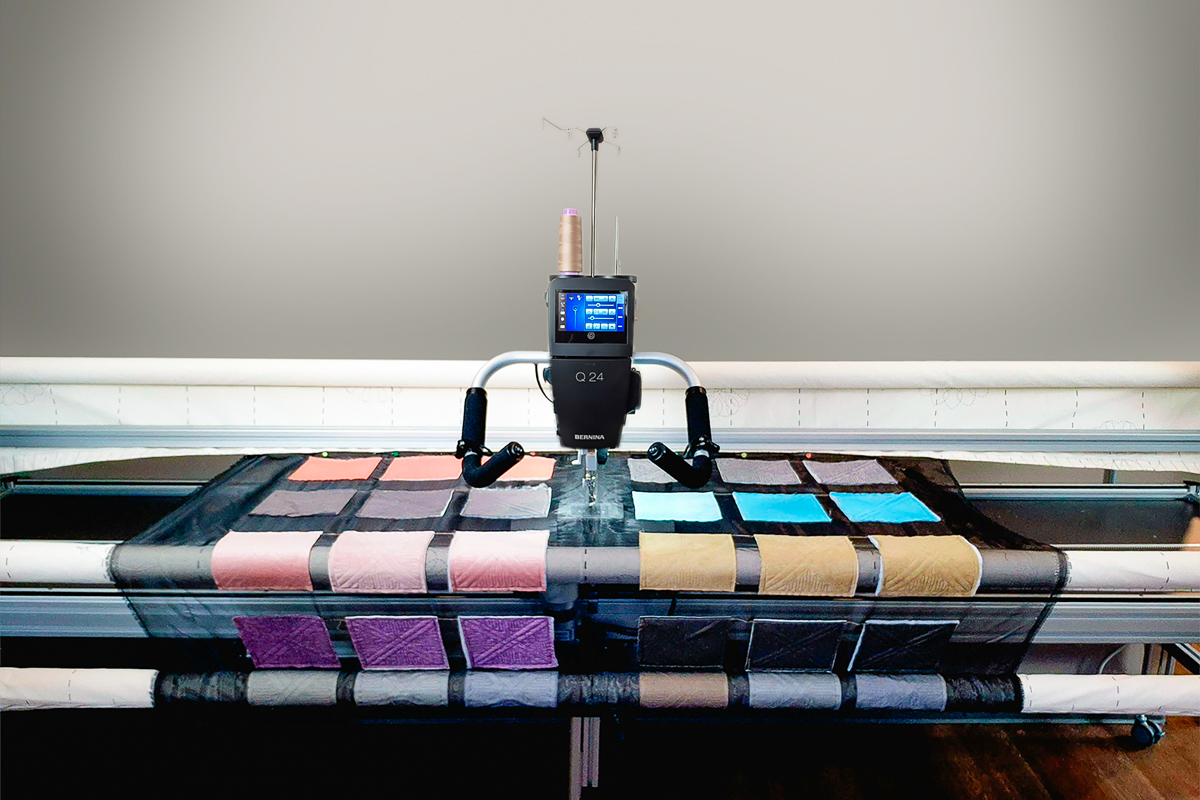
It’s true that longarms were invented for the challenging task of completing a quilt quickly. But just as a sewing machine can be turned into an embroidery machine, the BERNINA Q Series longarms are powerful enough and versatile enough to take on much more than quilts. I have a few projects on my wish list that involve quilting unusual fabrics. Which means I get to be a scientist and figure out the best methods for working with those fabrics. I am sharing my results with you in hopes that it inspires wild projects of your own. I look forward to comparing notes and seeing what we can make.
The first thing I did was gather a range of fabrics in various thicknesses and naps to see where the limitations would be. I grabbed a sampling of ten fabrics (the last one is a surprise at the end of the article) and cut them into 6” squares. I also cut squares of two types of batting: a 1/16” thin cotton and 3/16” lofty poly.

The fabrics I chose are, from left to right:
- Top row: twill canvas, wool tweed, and faux suede
- Middle row: velveteen, microfiber velvet, and suede upholstery
- Third row: tweed upholstery, cow leather, and cork
Because I want to line my projects separately from the quilted portion, I did something extra strange … I loaded a polyester organza as the foundation for my fabric swatches.
I basted three swatches of each fabric: one directly on the organza, one with the cotton batting, and one with the poly batting. I then stitched the same design on all the swatches and took notes as to the changes I made to make each swatch successful.
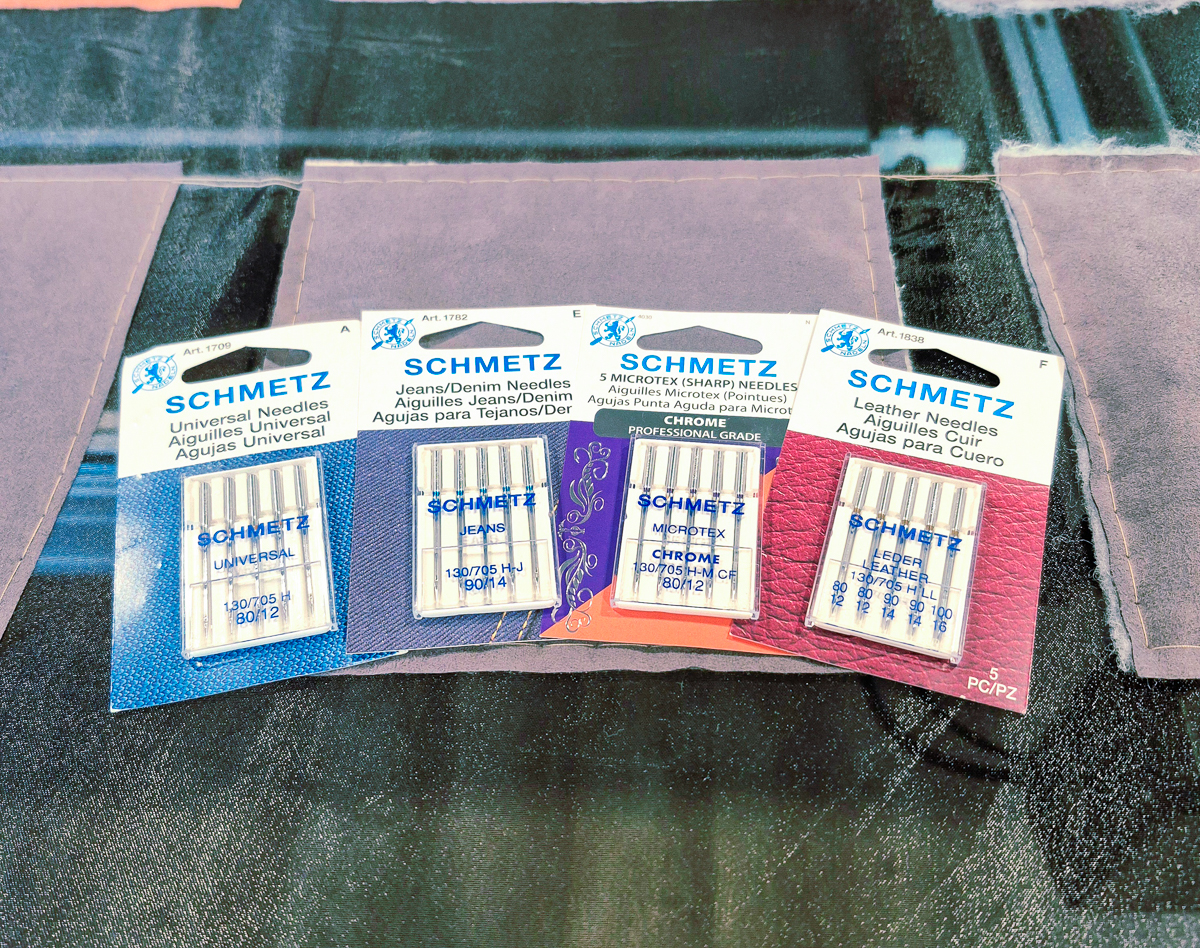
The BERNINA Q Series is unique from other brands of longarms because it uses the same domestic needles that I use on my sewing machine. You know, the ones with the flat back on the shank. So, I armed myself with an array of needles to choose from.
 Remember, for the samples in the photos, the far left has no batting, the middle has lightweight cotton, and the far right a thicker poly. I used the same thread (Seracor by Mettler, a 50-weight poly thread) on each swatch.
Twill Canvas
- Universal Needle 90/14
- Tension set to:
- 0 for the left swatch
- 0 for the middle and right swatches
- 10 SPI
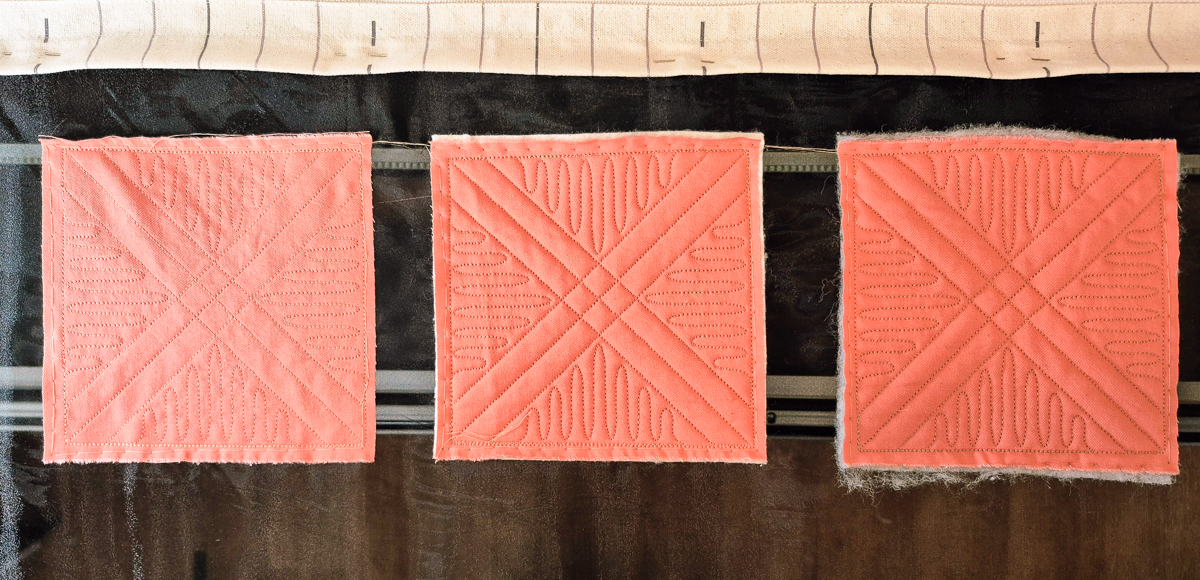
First up, I started with a universal needle (90/14) because that is what I would use if I were making pants out of this fabric. The first thing I noticed on the no-batting sample is that the bobbin thread tension was too tight. Since this machine is made for stitching through thick layers, I quickly adjusted the tension from its baseline of 4.0 to 5.0 and that evened out the stitches pretty quickly. The two swatches with batting did fine with the standard 4.0 setting and no adjustments.
Wool Tweed
- Universal Needle 90/14
- Tension set to:
- 0 for the left swatch
- 0 for the middle and right swatches
- 10 SPI
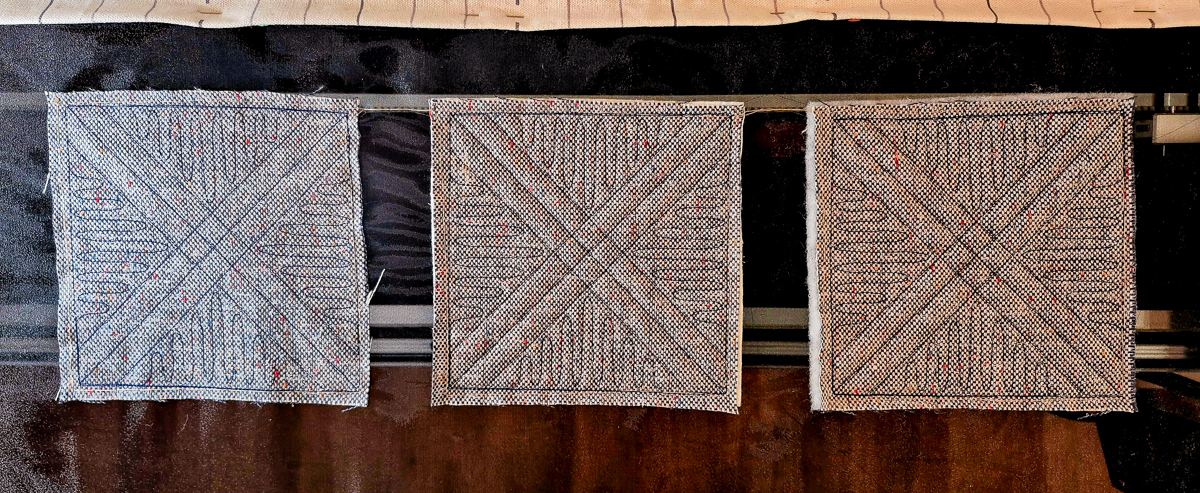
This set was the same. Adjusted the tension when there was no batting and set it back to default for batting. Although this tweed is neutral in coloring, I had to change the color of thread to even see where the stitching was.
Faux Suede
- Jeans 90/14
- Tension set to:
- 0 for the left swatch
- 0 for the middle and right swatches
- 10 SPI
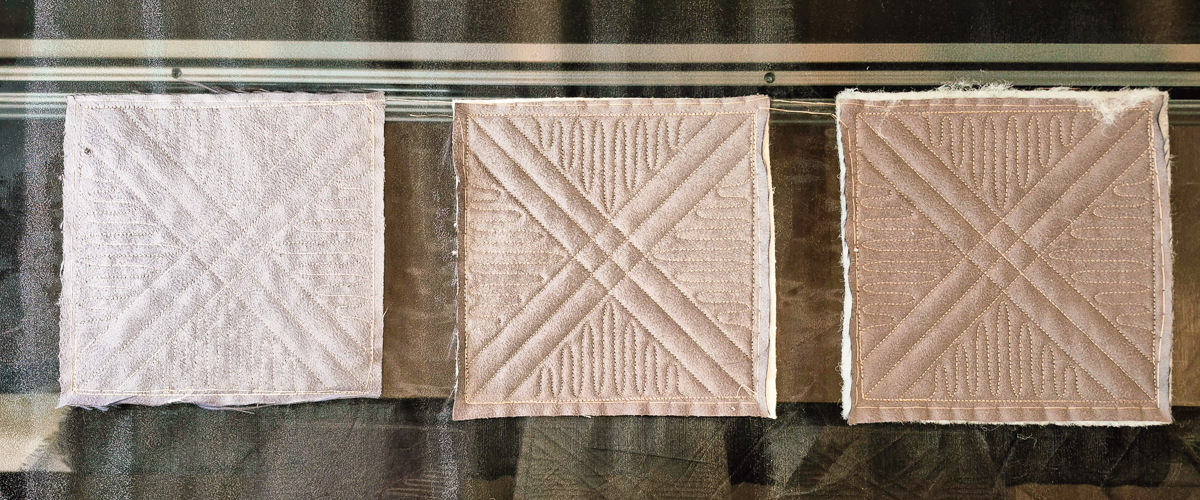
This faux suede is an interesting fabric. It seems that there is a base woven fabric that is flocked with texture. I switched to a jeans needle (90/14) because I wasn’t sure how the adhesive of the flocking might react to the needle. Turns out it was just fine. Same tension adjustments as the first two samples.
Velveteen
- Jeans 90/14
- Tension set to:
- 0 for the left swatch
- 0 for the middle and right swatches
- 10 SPI
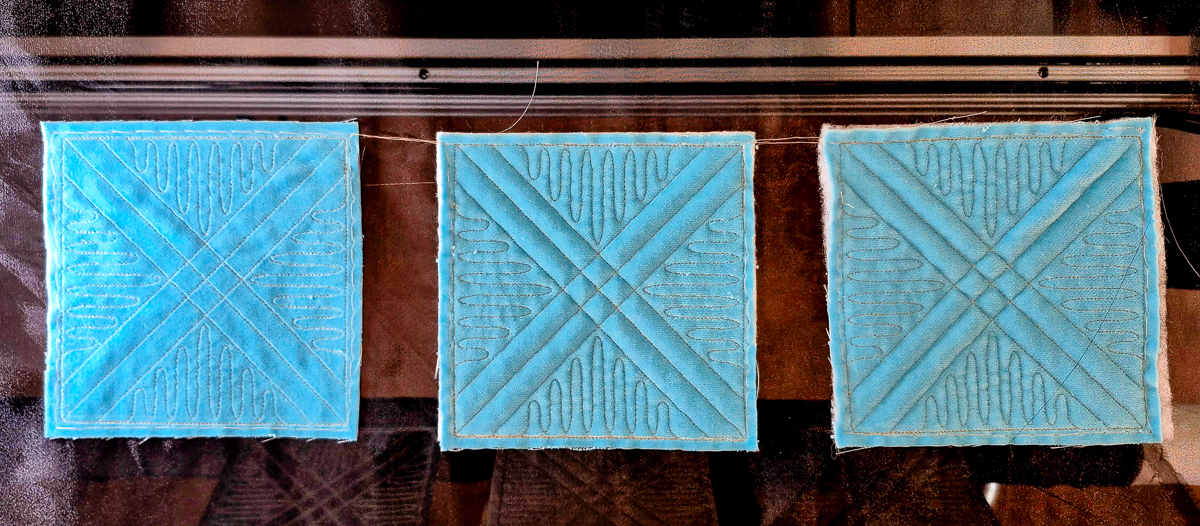
This velveteen was from the dress department. It is synthetic but not as heavy as upholstery. You might make a structured gown or cigarette pants out of it. I was excited to see how it would handle the nap and the no-batting swatch. I did not need to adjust the tension from 4.0. The interesting thing about the no-batting swatch is that the stitching is very subtle but visible. In the previous samples, the first swatch was about seeing the line of stitching on the fabric, like decorative stitching. However, on this velveteen, it is as if the stitching line is carved out of the nap. The swatches with batting would make great throw pillows, Christmas tree skirts or stockings. I like the puffier swatch as it shows off the light and shadows of the nap.
Microfiber Velvet
- Jeans 90/14
- Tension 4.0
- 10 SPI
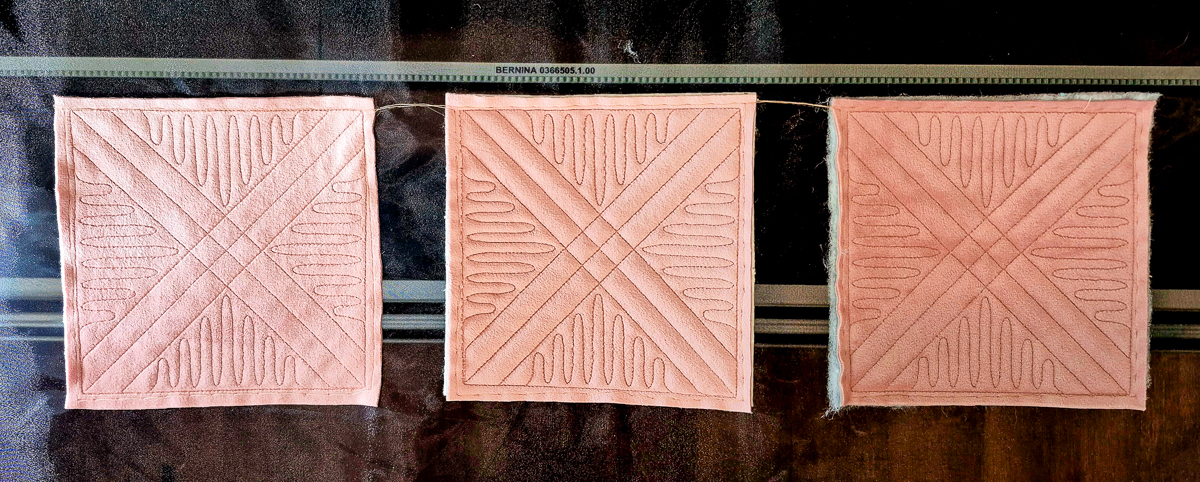
Talk about strange fabrics. I could not figure out how this was made. It looks like a nap woven into a wool base fabric that was then washed until it felted itself into a single mass, obscuring the warp and weft. I could not unravel or tear it. It is thicker than the velveteen but has a softer hand. I used the jeans needle, but suspect I could have used a universal because the fabric is so malleable. The 4.0 tension worked on all three samples. This would be cool as a lightweight jacket with a design stitched into it, but leave the felted side exposed as lining.
Upholstery Suede
- Jeans 90/14
- Tension set to:
- 0 for the left swatch
- 0 for the middle and right swatches
- 10 SPI
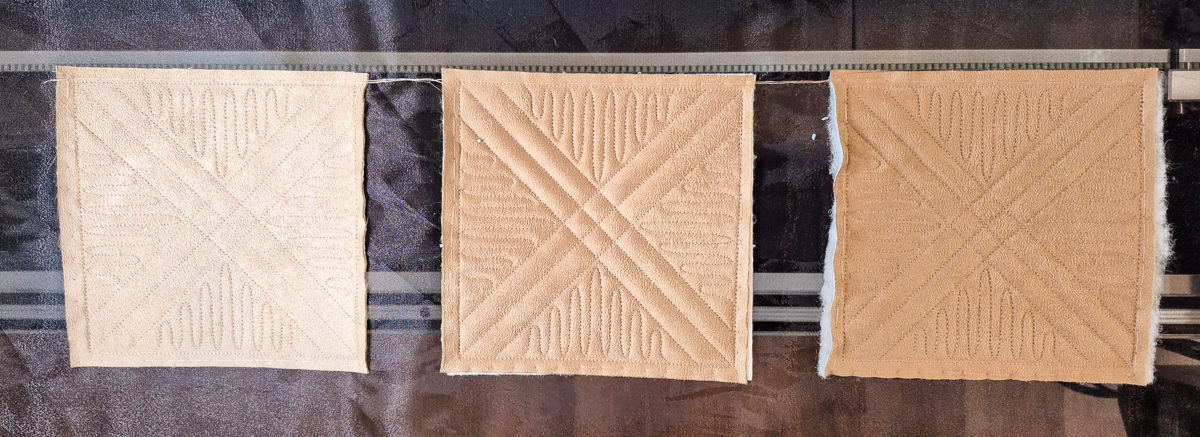
Things are starting to get thicker and tougher to stitch through! This upholstery suede, like the faux suede above, has a foundational canvas that is flocked. There is enough adhesive used in the making process that I could not unravel the cut edges. So I figured we’d better stay with the jeans needle (but I was ready to grab something stronger if needed). I adjusted the no-batting tension back to 5.0 because, although it is a tough fabric (the needle’s problem), it is a thin fabric (the tension’s problem). This would be fun as decorative elbow patches on a flannel jacket, or a quilted western jacket. And of course, suede throw pillows are always chic.
Upholstery Tweed
- Jeans 90/14
- Tension set to:
- 0 for the left swatch
- 0 for the middle and right swatches
- 10 SPI
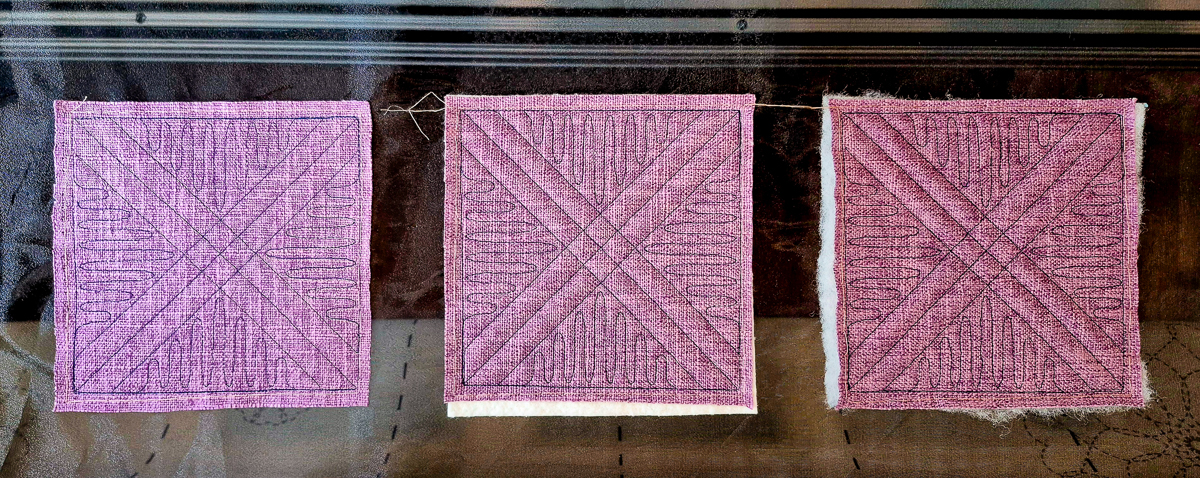
This is a beautiful fabric and would make a lovely sofa. The chunky weave and mottled color are beautiful on their own but completely obscured the stitching, so I switched to a dark thread so that I could examine the stitches. It is thin but has a stabilized backing that prevents the weave from stretching. I think the puffy poly batting was the most successful. If I were to quilt yardage of this fabric to use for upholstery, I would use matching thread and a high-loft batting to get the most light and shadow play on this lovely weave. There were no surprises while stitching it out.
Leather Cowhide
- Leather Needle 100/16
- Tension 3.0
- Slow down speed
- SPI 8
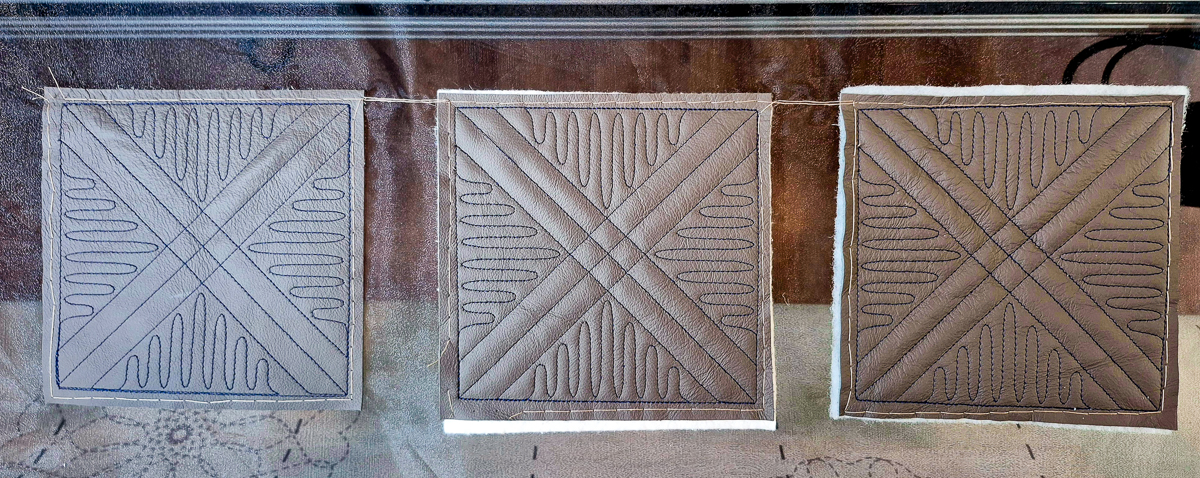
This was the first swatch that I was most excited — and equally nervous — about. This leather scrap was a bit spendy, even as small as it is, so there is no messing up. High stakes, to be sure, but I knew this had some very cool potential if it worked.
First, I changed the needle to a leather needle. The leather is roughly 1/6” thick, so I went with size 100/16 to be safe. When it started, the top thread was pulling to the top, so I adjusted the tension to 3.0. I think that the friction of punching through the leather and coming back out created drag on the thread. So, I also slowed down the machine and let it take its own sweet time to do this. I also changed to a longer stitch length of 8 SPI so as not to perforate the leather too much. It turned out great. When I use this for a real project, I think I will try using cotton fabric as the backing so it doesn’t have to work so hard on two fabrics. I love the look of the swatches with battings. This technique could be used for a very professional-looking handbag, elbow patches, or a jacket.
Cork
- Leather Needle 100/16
- Tension 4.0
- Slower speed
- 8 SPI
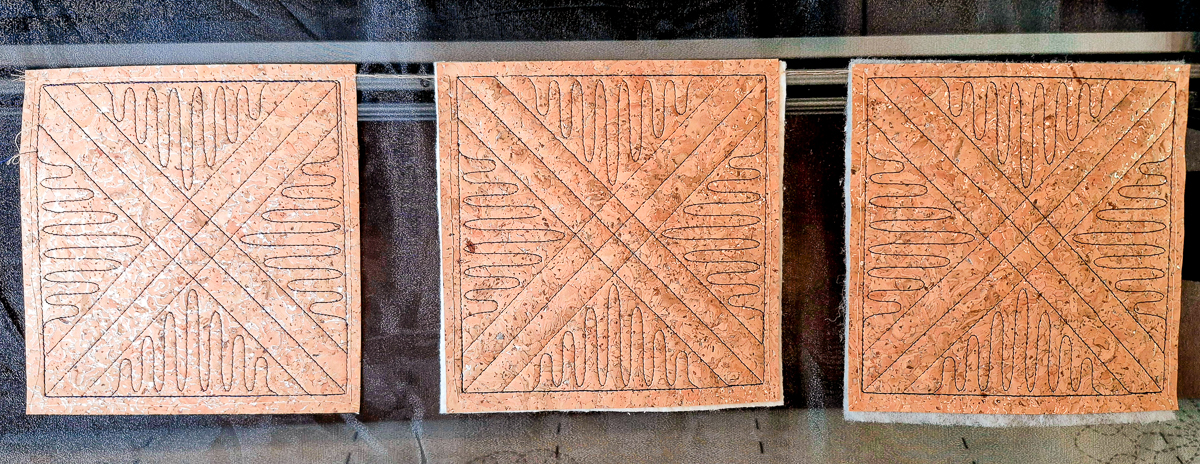
Cork fabric is more like vinyl in that there is a woven foundation adhered to a very thin layer of cork. This particular cork fabric is thin enough that a gold foil is sandwiched between the two layers and shines through the crevices of the cork. Therefore, I left the leather needle in and let it stitch slowly again. I also left the stitch length at 8 SPI because I think the longer length looks better. This looked so good that I immediately loaded some cork and whipped up a little beach bag.
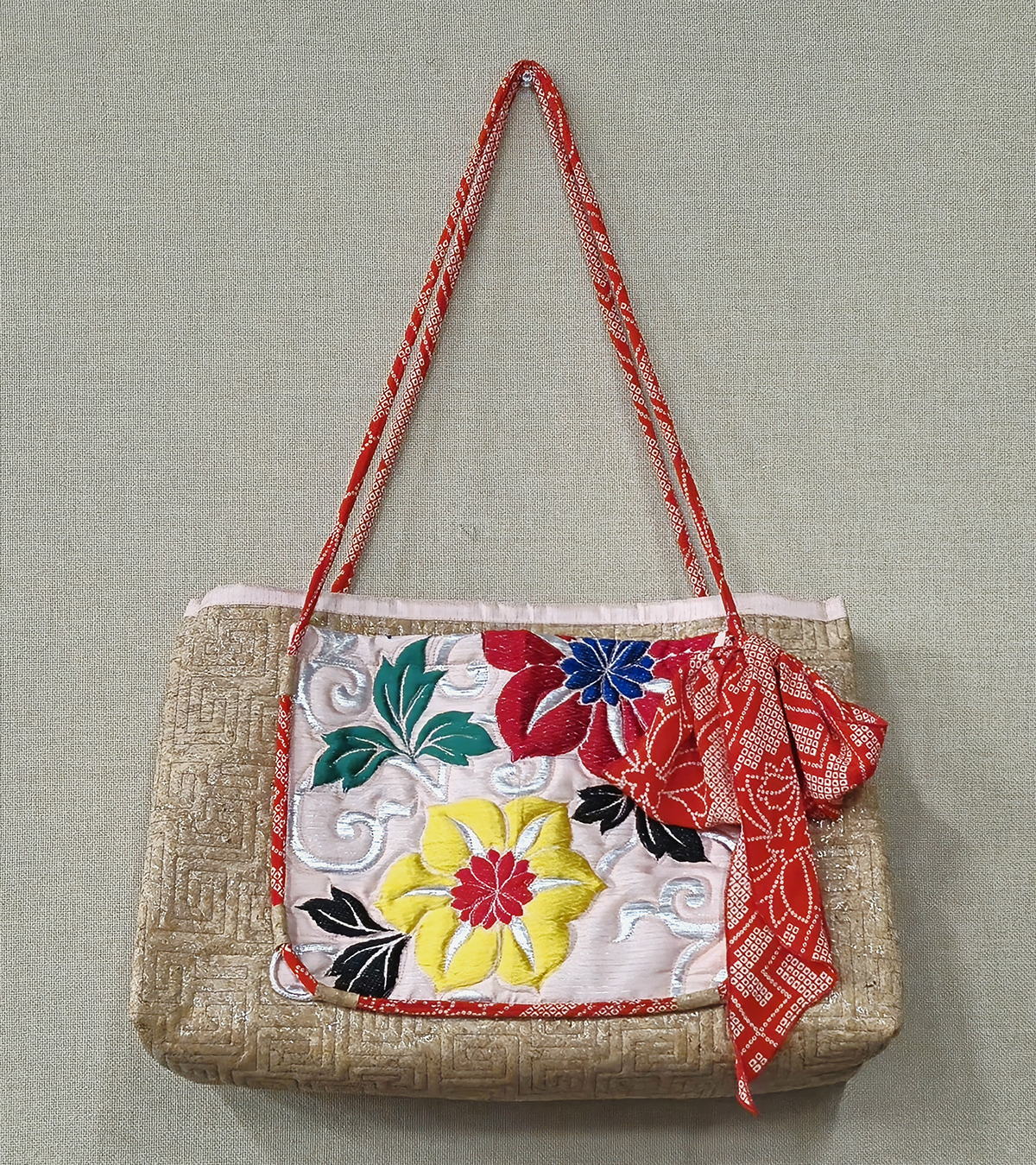
Bonus! Glitter Vinyl
- Leather Needle 100/16
- Tension 4.0
- Slower speed
- 8 SPI
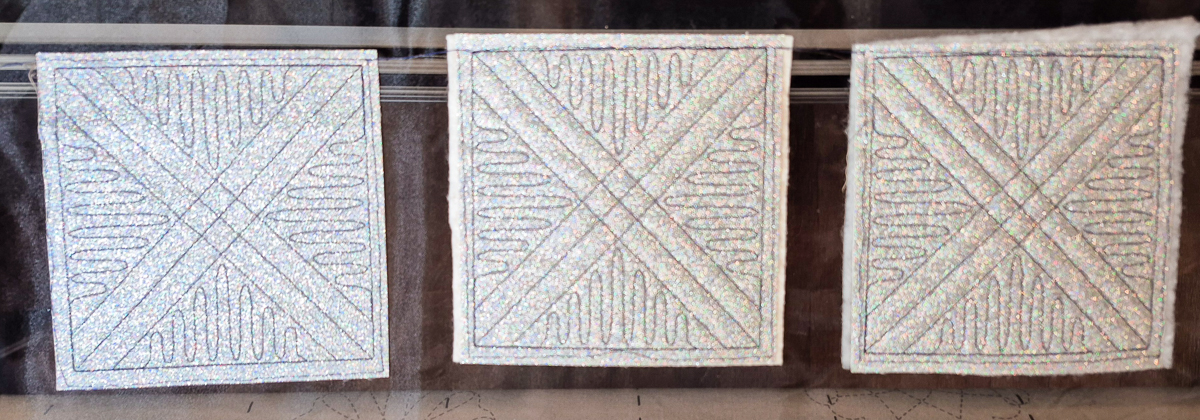
I’m a sucker for shiny things and, to be honest, since I made it through the leather, I was feeling invincible, so I threw on some glitter vinyl I had lying around. I didn’t change any settings from the cork and let it ride! The glitter doesn’t photograph well, but in person it sure is shiny! What would you make with this? I’ve been dreaming of some Christmas ornaments, and now I have the confidence to actually make them!
I hope that by seeing a test run of various fabrics and battings, you are inspired to think of your longarm differently. I have enjoyed making garments, bags, and holiday decorations by seeing what I can load on the longarm. I can’t wait to see what you will make besides your beautiful quilts.
Used Products
What you might also like
One comment on “Longarming Beyond Quilts: Unusual Fabric”
Leave a Reply
You must be logged in to post a comment.
Love, love, love this Lane! I did something similar YEARS ago with my Innova longarm and I definitely had more adjustments to figure out to get the stitch quality I was searching for. Of course our BERNINA longarm would make this all so much easier.